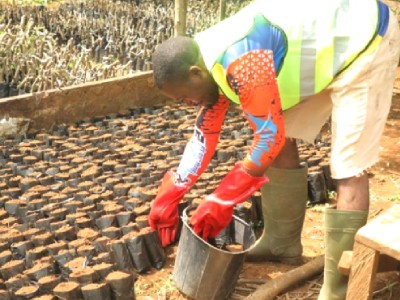
Shed Tree Project Create Your Journey Across several urban centers in Cameroon, the presence of wild street trees — once planted with good intention — has become an urgent safety and environmental concern. These trees, uncontrolled and unmanaged, have matured into hazards. Their branches interfere with power lines, collapse onto property, and pose risks to public safety. Felling them often results in collateral damage to fences, infrastructure, and roads, while the replanting process introduces further economic strain. The Foundation for the Assistance of Further Studies and Research (FAFSAR) recognized this silent crisis early and responded with a solution grounded in applied research and long-term vision: The Green Canopy Initiative, a comprehensive project designed to replace hazardous street trees with a safe, scientifically selected species — Alstonia scholaris, widely known as the “miracle tree.” Project PDF Green Adventure FAFSAR has already introduced Alstonia scholaris in targeted demonstration sites such as the Limbe District Hospital and residences in Mokindi and Bota. These trees now stand as proof-of-concept specimens — healthy, shaped, and contributing to the beauty and functionality of public spaces. This initiative did not begin as a simple tree-planting campaign. FAFSAR conducted field research across six towns and hillside communities, assessing the condition and risks posed by existing trees and identifying the ideal species that could fulfill multiple ecological, aesthetic, and safety roles. The conclusion was clear: the Alstonia scholaris, unlike the wild, unmanaged trees currently lining streets, offers a well-defined canopy, manageable branching structure, and a range of environmental and public health benefits. Known for its resilience, regenerative properties, and adaptability to various soil types, the tree emerged as a viable long-term replacement across urban and semi-urban zones. What Sets Alstonia scholaris Apart The qualities of the Alstonia scholaris make it uniquely suited for urban restoration: Its structured growth and prunable canopy allow cities to develop uniform, organized landscapes. It regenerates naturally after being cut or pruned, significantly reducing future replanting and maintenance costs. Its large leaves absorb dust and pollutants, improving urban air quality. The tree’s strong roots support soil stabilization and erosion control, especially in flood-prone zones. It is medically valued for respiratory, immune, and digestive benefits, traditionally used in community-based healing practices. Culturally, it enhances community life, offering cool shaded areas for social gatherings, meals, weddings, and rest. Nursery Development and Methodology To ensure the availability of high-quality seedlings, FAFSAR established a dedicated nursery capable of producing tens of thousands of weather-resistant plants. The nursery trials have involved: Testing various soil types to evaluate root health and plant adaptation. Propagation through cuttings, increasing efficiency in mass multiplication. Monitoring growth through multiple seasons to assess durability and climate responsiveness. The current stock — now exceeding 10,000 young plants — is a testament to the initiative’s readiness. These trees have not yet been deployed at large scale. Instead, they are being nurtured to maturity and reserved for a planned, systematic rollout, pending donor and stakeholder support. Our Objectives and Five-Year Vision FAFSAR’s Green Canopy Initiative has defined goals aimed at transforming Cameroon’s public spaces while reducing risks and municipal costs: Replace hazardous wild trees with Alstonia scholaris in towns and cities. Prevent infrastructure damage during felling operations by introducing manageable, predictable trees. Unify city landscapes with neatly pruned, aesthetically pleasing tree lines. Reduce urban heat and improve community health through better air and ground conditions. Strengthen climate resilience with deep-rooted trees that prevent erosion and regenerate naturally. Minimize replanting costs by investing in a species that thrives after being cut or shaped. FAFSAR aims to complete this replacement cycle within five years, beginning with towns already surveyed and ready for reforestation efforts. Toward a Greener, Safer Cameroon: A Call for Support This initiative has reached a critical point. The research has been conducted. The nursery has been developed. The trees have proven themselves. What remains is the transition from nursery to street, from vision to urban reality. To achieve this, FAFSAR is calling on donors, development partners, institutions, and environmentally committed individuals to support the Green Canopy Initiative. Supporting this project means: Investing in urban safety by removing hazardous tree species. Funding a sustainable, low-cost urban forestry model with long-term impact. Supporting job creation in nursery management, planting, and environmental education. Contributing directly to Cameroon’s climate adaptation and resilience goals. We invite you to be part of a solution that blends science, tradition, and practicality. Each contribution brings us closer to a Cameroon where communities gather under safe, leafy canopies — where cities breathe better, streets grow cooler, and nature coexists in harmony with human development.